
CFP: Conference “Privacy Outside Its ‘Comfort Zone’: Late Socialist Eastern and East-Central Europe between the Private and the Public” (Univ. of Passau)

Deadline for Submissions: February 28, 2017

CfP Conference “Privacy Outside Its ‘Comfort Zone’: Late Socialist Eastern and East-Central Europe between the Private and the Public”

“Privacy” is a well-researched yet highly disputed concept in Western scholarship. While most privacy research comes from and concentrates on Western liberal societies, great potential of privacy studies beyond this traditional framework still remains largely unexplored. The framework of Western liberal societies may therefore be seen not only as a “comfort zone” of privacy studies, but also as a barrier that often limits the potential of the research. This conference aims at elucidating the problems and the perspectives of privacy studies beyond the traditional liberal framework by bringing together scholars and PhD students who work on the concept of “privacy” in the context of Late Socialist Eastern and East-Central Europe.
A common challenge to privacy researchers of non-Western societies, especially if they come from such a society, is to refute the erroneous misconception of the absence of “privacy” in non-liberal societies, and to embrace the constructions of “privacy” that these local societies offer. This conference endeavors to create a dialogue between scholars and PhD students from all fields of humanities and social and political sciences to discuss the challenges of transgressing the borders of liberal frameworks, the strategies to cope with these challenges, and the perspectives for privacy research that such transgressions offer.
The use of this concept in the context of Late Socialist Eastern and East-Central Europe leads to a range of questions that challenge liberal dichotomies and pave the way for alternative visions of “privacy”. These questions are particularly resonant now, in the centennial year of the October Revolution, when its consequences are debated anew. While the liberal concept of “privacy” usually fails in the framework of authoritarian regimes of post-war Europe, the region offers a diversity of other impulses similar to the liberal idea of “privacy”. In the post-war years, Socialist Eastern and East-Central Europe witnessed the expansion of the material as well as immaterial private sphere, which did not only come as a result of the changed world order and subsequent transformations of Socialist societies, but can also be seen as a process that was meticulously planned, carried out, and controlled by the authorities of respective countries in an attempt to stabilize their regimes in the process of de-Stalinization. However, we should also consider whether the private sphere, so benevolently tolerated by Socialist states, continuously developed into an enfant terrible that nurtured not only stability, but also the disruptive forces of dissidence and civil rights movements, which ultimately undermined the Socialist bloc from within. These stabilizing and simultaneously disruptive currents of “privacy” within non-liberal societies are of particular interest, as they elucidate the multifaceted nature of this concept.
Participants are therefore asked to revisit and question the concept of “privacy” in liberal contexts as well as within the frameworks of Late Socialist Eastern and East-Central Europe by renegotiating the underlying categories within a certain society. The conference will specifically examine ways of addressing the concepts of “privacy” and “publicity” in said contexts by debating the applicable frameworks and by challenging existing approaches. It will further explore the potential of “reverse applicability” by discussing how privacy research in liberal contexts can benefit from other frameworks of privacy—the transfer that is of particular interest now, in the “post-privacy age”, when Snowden’s revelations elucidated the approximations of Western liberal states to the authoritarian models of the past and the present. In the light of such developments, the examination of Late Socialist authoritarian societies becomes advantageous for our understanding of contemporary privacy paradigms.
Continue reading “CFP: Conference “Privacy Outside Its ‘Comfort Zone’: Late Socialist Eastern and East-Central Europe between the Private and the Public” (Univ. of Passau)”

Funding Opportunity: Explore the World Travel Scholarship (Hostelling International USA)

Deadline for Applications: March 15, 2017

Hostelling International USA is still accepting applications for our Explore the World Travel Scholarship.

This is a $2,000 travel scholarship being offered for Austin Area residents, and this year we’re awarding 5 scholarships.

Also, HIU is hosting a World Travel 101 Travel Class at REI Downtown on Tuesday, Feb 28th at 6:30 pm if you or anyone you know is interested in learning more about international travel and more about the scholarship. Here is a link to learn more about what the class will cover and to RSVP. It’s a free class, but requires an RSVP since they do fill up quickly.

The scholarship is open to individuals, ages 18-30, who will engage in an educational or service learning component during their trip.  Eligible candidates must also meet specific financial need requirements. More information can be found at www.hiusa.org/travel-scholarships.

Application deadline: March 15, 2017

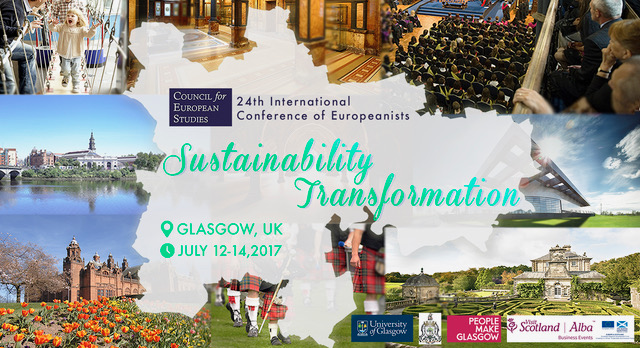
Conference: 24th International Conference of Europeanists (Glasgow, UK)

Date of Conference: July 12-14, 2017

Open book - very shallow dof

The 24th International Conference of Europeanists in Glasgow promises to bring together a wide range of experts  to present and debate new research on critical, timely topics such as Brexit vote, the immigration crisis, the stability of the Eurozone, the resurgence of populist political movements, and the opportunities and challenges of technological advances in artificial intelligence and data gathering. The conference also features a set of exhibits, digital and print advertising, and numerous sponsored special events. Here are some program highlights and events that we’re already looking forward to!

Keynote Speaker: Judy Dempsey

Judy Dempsey is a nonresident senior associate at Carnegie Europe and editor-in-chief of its blog, Strategic Europe. Prior to joining Carnegie in 2012, Dempsey had a long and distinguished career in journalism. She was a columnist for the International New York Times after serving as the International Herald Tribune’s Germany Correspondent between 2004-2011.

Before moving to Berlin, Dempsey was the diplomatic correspondent for the Financial Times in Brussels (2001-2004), covering the big NATO and European Union enlargements. Between 1990 and 2001, she was the FT’s Jerusalem bureau chief (1996– 2001), Berlin correspondent (1992–1996), and Eastern European correspondent. (1990–1992). During the 1980s, Dempsey reported on Central and Eastern Europe and the Balkans for the Financial Times, the Irish Times, and the Economist from Vienna.

Dempsey graduated from Trinity College, Dublin, where she studied history and political science. She has contributed to several books on Eastern Europe. In 2013, her book on Chancellor Angela Merkel “Das Phänomen Merkel” was published (Edition Körber-Stiftung,) to critical acclaim. She has also published Carnegie papers on NATO and on Germany.

CFP: XXII International Conference “Slavic Readings” (Daugavpils U.)

Deadline for Submissions: March 01, 2017

The Department of Russian and Slavic Linguistics of Daugavpils University is pleased to announce the XXII International Conference „Slavic Readings” to be held at DU, Daugavpils (Latvia), on May 18-19, 2017.

The conference welcomes presentations of research done on contemporary issues of Russian and Slavic studies, and functioning of the Russian language, literature and culture in a foreign language environment.
The Conference will work in the following sections:

1. Contemporary issues of Russian and Slavic studies (a theoretical aspect):
– Slavic languages: historical and contemporary context.
– Literature of the Slavs: historical and contemporary context.
– Slavic-Baltic language, literature and culture connections.
– Russian literature within the world literature context.

2. Russian language, literature and culture in a foreign language environment (a pragmatic aspect).
– Studying Russian literature and culture in the modern world.
– Russian language in a multicultural environment.
– Innovative methods of teaching Russian as a foreign language. Continue reading “CFP: XXII International Conference “Slavic Readings” (Daugavpils U.)”

Funding Opportunity: Elizabeth Barman Museum Internship (Archaeological Institute of America)

Deadline for Applications: April 01, 2017

Title: Elizabeth Bartman Museum Internship
Sponsor: Archaeological Institute of America
Amount: $2,000 – $4,750

Description: A scholarship established in honor of AIA Past President Elizabeth Bartman to assist graduate students or those who have recently completed a master’s degree with the expenses associated with participating in a museum internship either in the United States or abroad. The internship fund is intended to help graduate students, or those who have recently completed a master’s degree, in Archaeology or a related field (e.g., Anthropology, Art History, Classics, History, etc.) meet expenses associated with undertaking a museum internship (minimum duration a summer or semester). Specific projects will vary and might include the following: collection cataloguing, provenance or archival research, exhibition preparation, the writing of labels and/or didactic panels, assisting with websites and presentations in other media, such as audio guides and exhibition videos, and participating more broadly in museum activities, working with conservators, art handlers, designers, and other museum professionals. Applicants must be members of the AIA at the time of application. 

How to Apply: Apply directly to the sponsor by April 1. See the announcement for a list of materials to be submitted with the application. 

More Info: https://www.archaeological.org/grants/16811

Funding Opportunity: Public Fellows Competition for Recent Ph.D.s (ACLS)

Deadline for Applications: March 22, 2017

Title: ACLS Public Fellows Competition for Recent Ph.D.s
Sponsor: American Council of Learned Societies (ACLS)
Amount: $67,500/yr., 2 yrs.

Description: ACLS invites applications for the seventh competition of the Mellon/ACLS Public Fellows program. This year, the program will place up to 22 recent PhDs from the humanities and humanistic social sciences in two-year term staff positions at partnering organizations in government and the nonprofit sector. Fellows will participate in the substantive work of these organizations and receive professional mentoring. Fellows receive a stipend of $67,500 per year, with individual health insurance and up to $3,000 to be used toward professional development activities over the course of the fellowship term.  This initiative, made possible by a grant from The Andrew W. Mellon Foundation, aims to expand the role of doctoral education in the United States by demonstrating that the capacities developed in the advanced study of the humanities have wide application, both within and beyond the academy. The Mellon/ACLS Public Fellows program allows PhDs to gain valuable, career-building experience in fields such as public policy, development, conservation, arts and culture, and digital media. 

How to Apply: Apply directly to the sponsor by March 22. See the grant announcement for a complete list of materials to be submitted with the application.

More Info: http://www.acls.org/programs/publicfellowscomp/

Study Abroad: Faculty of Economic Sciences (Higher School of Economics)

Deadline for Applications: April 15, 2017

The Moscow-based Faculty of Economic Sciences at the Higher School of Economics, a highly selective educational institution specializing in economics and finance,  would like to invite undergraduate and Master’s-level students to experience study abroad at one of Russia’s best universities.

HSE is one of Russia’s largest and most modern state universities. Established in 1992 as a program in economics, HSE currently offers 87 programs in 16 areas of study for undergraduate students and 129 Master’s programs in 28 areas of study. 25 Master’s programs are currently taught entirely in English. At its four campuses – in Moscow, St. Petersburg, Perm and Nizhny Novgorod – HSE offers instruction to more than 30,000 students each year.

Because HSE attracts the best and brightest from throughout Russia, most students have a high level of proficiency in English. The undergraduate program offers a wide variety of courses taught in English in the fields of economics, humanities, finance and the social sciences. Students from abroad can take classes in English from other HSE programs as well as study Russian as a Foreign language.

Undergraduate students enjoy a wide variety of liberal arts courses that combine humanities and science in a balanced way that suits majors such as:

  • Slavic Languages and Literatures

  • Economics

  • Economics and Mathematics

  • Finance

  • Political Science

  • Russian and East European Studies

  • Global Affairs

  • Humanities

Continue reading “Study Abroad: Faculty of Economic Sciences (Higher School of Economics)”

CFP: “The Russian Revolution and Its Legacies: Taking Stock a Century Later” (Tartu, Estonia)

Deadline for Submissions: February 20, 2017

SECOND ANNUAL TARTU CONFERENCE
ON RUSSIAN AND EAST EUROPEAN STUDIES

The Russian Revolution and Its Legacies: Taking Stock a Century Later
4-6 June 2017, Tartu, Estonia

Scholars working in all subfields of area studies, including comparative politics, international relations, economics, history, sociology, anthropology, cultural studies and related disciplines, are invited to submit proposals for panels, roundtables and papers for the Second Tartu Conference on Russian and East European Studies.

The Tartu Conference is a venue for academic discussion of the fundamental cultural, social, economic and political trends affecting all aspects of people’s life in Russia and Eastern Europe. The First Tartu Conference, held in June 2016, brought together more than 200 scholars from across multiple disciplines, from the region and beyond.

Participants of the 2017 conference are invited to share their reflections on the Russian revolution of 1917 and the ensuing developments in Russia, Eastern Europe and elsewhere in the world. How are they represented and interpreted today by professional historians, various political actors and the wider public? What was their impact on culture, the economy, political systems, ideologies and social structures? Which legacies and path-dependencies going back to 1917 continue to be relevant today for memory politics, value systems, social institutions, the economy and international relations? What does an analysis of 1917 and its legacies contribute to the comparative study of revolutions? How can the liberating potential of popular struggles against exploitation and oppression be harnessed, and can social orders be transformed without resorting to violence? How do we keep alive the memory of the victims of twentieth-century totalitarianism and defend democracy against mounting challenges? Continue reading “CFP: “The Russian Revolution and Its Legacies: Taking Stock a Century Later” (Tartu, Estonia)”

CFP: “Late Socialism: Second-World Modernity in Global Circulation” (U. of Pittsburgh)

Deadline for Submissions: March 01, 2017

CALL FOR PAPERS
for Studies in Slavic Cultures XIV
Late Socialism: Second-World Modernity in Global Circulation

This volume of Studies in Slavic Cultures invites contributions that explore the culture of Late Socialism from a transnational perspective. Taken to be the period from the death of Stalin to the beginning of Perestroika (mid-1950s to the mid-1980s), Late Socialism is not merely a transitionary phase between a totalitarian regime and the liberalizations of impending collapse. Rather, it is a period with rich potential to explore the particularity and comparability of second-world modernity in a cross-cultural framework.

This period is marked by increasing international contacts and cross-cultural transfers not only with the Western world, but also with the cultures and subcultures of Asia, Africa and Latin America. Scholarship on Russo-Soviet culture often oscillates between two overreaching claims. On the one hand, some Slavists interpret Russo-Soviet culture, history, and politics as sui generis, invoking a long tradition of an exceptionalist Russia, as “neither East nor West.” On the other hand, a competing tendency has insisted upon a comparitivist Russia, one in which Russia belongs to the same temporal-spatial modernity as Europe, yet inevitably therefore “backward” on a shared scale of cultural development.

Taking insight from Michael David-Fox’s Crossing Borders, which convincingly deconstructs this binary opposition in favor of an alternative lens “marked by webs of meaning, multicausal explanations, and pluralistic rather than exclusionary interpretive frameworks,” we invite articles that examine the particularities of Late Socialist culture, putting them into diverse geopolitical and cross-cultural constellations. Continue reading “CFP: “Late Socialism: Second-World Modernity in Global Circulation” (U. of Pittsburgh)”

Study Abroad: Summer Intensive Russian and Kazakh and Elective Courses in Eurasian Studies (Astana, Kazakhstan)

Deadline for Applications: March 01, 2017

Nazarbayev University (Astana, Kazakhstan), in collaboration with the University of Arizona, is pleased to announce the Second Summer School in Russian and Eurasian Studies (SSRES). We are now accepting applications from undergraduate and graduate students, as well as working professionals for our 2017 summer session. The deadline for applications is March 1, 2017. Program dates for SSRES 2017: May 26-July 22 (8 weeks)

The main component of SSRES in 2017 will be an Intensive 8-week Course in Russian Language (all levels are welcome) OR an Intensive 8-week Course in Beginner’s Kazakh Language. The program offers 120 contact hours of in-class instruction in all aspects of these languages and one elective course in the Eurasian Studies curriculum taught in English. Students can choose one from the following elective courses:

  • HST 100 History of Kazakhstan (6 ECTS or 3 Carnegie)
  • HST 104 Central Asian History II (6 ECTS or 3 Carnegie)
  • WLL 230 Survey of Post-Soviet Russian Literature and Culture (6 ECTS or 3 Carnegie)

In additional to the core program, the students will have an opportunity to learn some elementary Kazakh and get an introduction to Kazakh culture by taking a weekly non-credited practical course in Kazakh Language and Culture (once a week on Fridays, free and included in the program). Students, enrolled in Kazakh, will be able to take a similar course in Russian Language and Culture.

American students have an option to apply to the program through The University of Arizona Global Initiatives and earn US-based academic credits. The University of Arizona offers full health insurance coverage, pre-departure orientation and advising sessions, and 24/7 counselling services to all program participants.  For more information, visit the program’s website at https://global.arizona.edu/study-abroad/program/arizona-kazakhstan.

For more information about the program, including its cost, course descriptions, and the cultural program, visit our website: http://shss.nu.edu.kz/shss/academics/ssres and the program blog at http://ssres-nazarbayev-university.com/. Please address all questions to Professor Victoria Thorstensson (victoria.thorstensson@nu.edu.kz). 

Questions about the application process through the University of Arizona should be addressed to Professor Liudmila Klimanova, Director for the Arizona in Kazakhstan Program (klimanova@mail.arizona.edu).  Continue reading “Study Abroad: Summer Intensive Russian and Kazakh and Elective Courses in Eurasian Studies (Astana, Kazakhstan)”