Prof. Devel.: Training Seminar for International Electoral Observers (EIUC)

Deadline for Applications: February 12, 2017
3-ieo-2017-tw

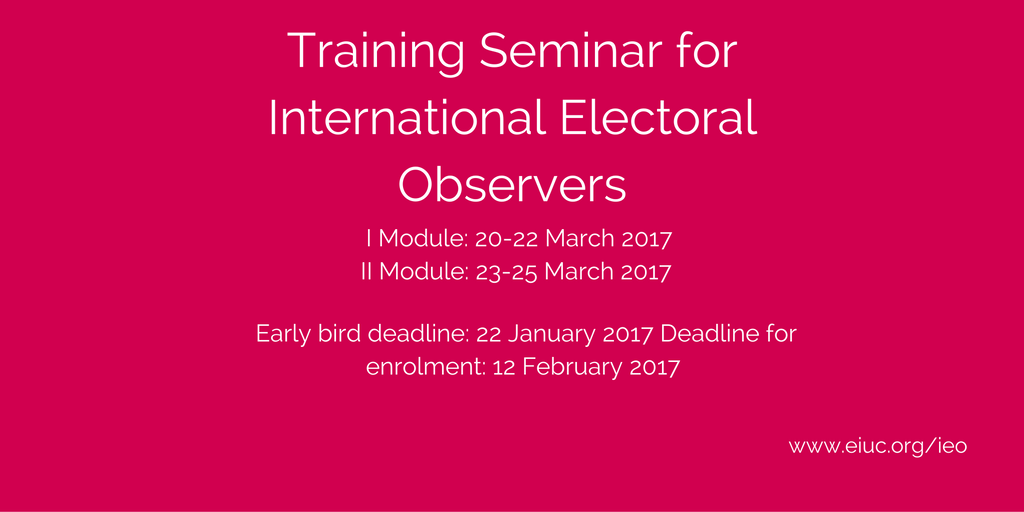
Training seminar for International Electoral Observers

Admissions to the two, three-day, modules (20-22 March 2017 and 23-25 March 2017) of the Training seminar for International Electoral Observers are open until 12 February 2017.

Open and legitimate elections are the indispensable foundation for sustainable development and an effective democracy. Actions supporting the right to participate in genuine elections can play a major role in sustaining peace, security and conflict prevention. Support takes the form of electoral assistance projects and election observation missions. This requires skilled and trained observers.

Target: The two modules are devoted to those applicants with no experience in election observation or to those observers who have participated to a maximum of two missions as short term observers.

Eligibility: Lectures are conceived for an audience of graduates mainly in Law, Political Sciences, Economics, Sociology, Philosophy, Anthropology or similar who want to address international election observation from a multi-disciplinary approach that will be useful in further engagements on the field.

Training language: all courses will be held in English. It is, therefore, essential that all participants understand and speak English fluently.

More information on the Training seminar for International Electoral Observers and the programme can be found here: www.eiuc.org/ieo
CFP: Fourth Annual Polish Studies Conference (Chicago, Illinois)

Deadline for Submissions: February 10, 2017

“MODERNIZATIONS”
4th Annual Polish Studies Conference at the University of Illinois at Chicago
April 24-25, 2017

 Organizers: Professor Michał Paweł Markowski (Hejna Family Chair in Polish Language and Literature) & Professor Keely Stauter-Halsted (Hejna Family Chair in the History of Poland)

Poland has long been the focus of modernization theories, schemes, and projects. From Enlightenment travelers critiquing the Polish lands for their backwardness and incivility to communist ideologues intent on the revolutionary transformation of society, Poles have been engaged in conversations about modernization for most of the past two centuries.

Modernization—the notion of a transformation from a traditional, rural, agrarian society to a secular, urban, and industrial one—has recently experienced a decline in reputation. Until 1918 modernization programs helped move the nation forward while the political existence of the state was denied, often pitting intellectual and economic agendas against nationalist ideologies supported by the Church. After independence, modernization goals drove the Second Republic to fight decades of underdevelopment in order to keep pace with liberal democracies across Europe. Later, modernization became a buzzword for the Communists, justifying grandiose social engineering projects. More recently, the integration of Poland and the Poles into the European Union has brought economic benefit, but social dislocation and insecurity, providing fodder for debates about the value of modernization. In all of these cases, modernization has been skillfully manipulated as an ideological weapon in battles over power, influence, and the control of public opinion. The massive political turnout and populist movements currently taking power worldwide suggest a reversal in the way ideas of modernization have resonated. In Poland, some have suggested that the rise of the Law and Justice party in 2015 came about through the Party’s explicit resistance to modernization, especially as it had been employed in Civic Platform’s neoliberal economic programs.

What have all these versions of modernization meant to Poland and to Poles? How can we as scholars understand the ways modernization schemes have affected Polish society? The centrality of modernization tropes in Modern Polish history demands careful investigation. We invite proposals for presentations to consider different accounts of how modernization has been used in the last 150 years and to look closer at how its enthusiasts and its detractors continue fighting one another, even while claiming to share a concern for a better future of the Polish nation.  Continue reading “CFP: Fourth Annual Polish Studies Conference (Chicago, Illinois)”

Prof. Devel.: Online Dissertation Workshop for Russian, East European, and Eurasian Studies Students (U. of Illinois, Urbana-Champaign)

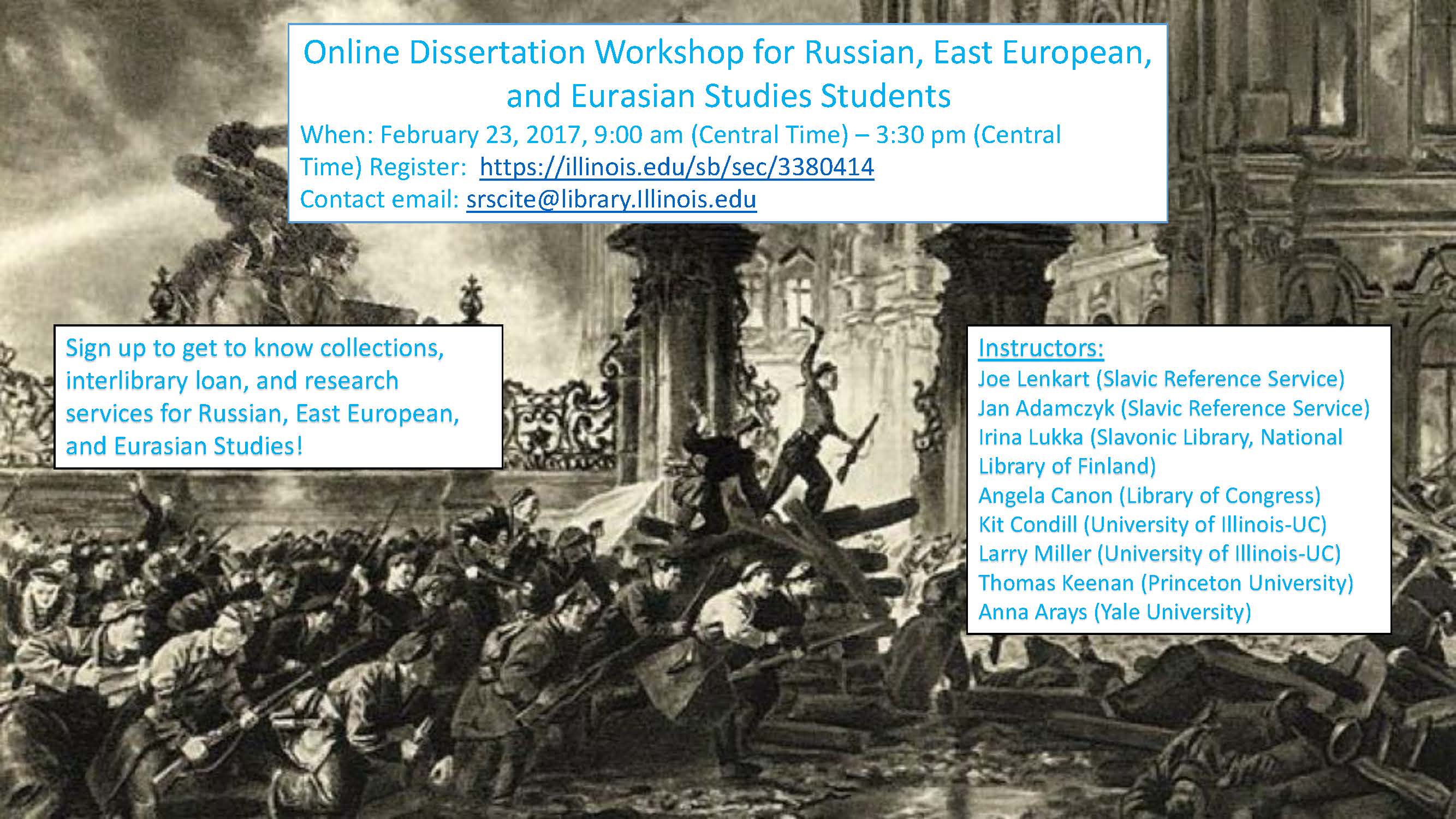
Date & Time: February 23, 2017, 9:00-3:30pm (CT)

The Slavic Reference Service is teaming with Slavic librarians from prominent research institutions to offer an online doctoral dissertation workshop for REEE students on Feb. 23, 2017, from 9:00 am – 3:30 pm (Central Time).  There are eight individual sessions as part of this workshop.

Register at: https://illinois.edu/sb/sec/3380414

online-doctoral-dissertation-workshop-for-reee-studies-2017-poster

Workshop Program:

9:00 am – 9:15 am: Introduction (Joe Lenkart)
9:15 am – 9:45 am: REEE materials and Interlibrary Loan (Jan Adamczyk)
10:00 am – 10:30 am: Collections and Access Services for International Researchers at the Slavonic Library, National Library of Finland (Irina Lukka)
10:45 am – 11:20 am: Collections and Services at the Library of Congress (Angela Canon) 11:30 am – 12:00 pm: Regional Research Resources for Doctoral Students (Joe Lenkart) 12:30 am – 1:15 pm: REEE Collections at Princeton University (Thomas F. Keenan)
1:30 pm – 2:15 pm: REEE Collections at University of Illinois at Urbana-Champaign (Kit Condill and Larry Miller)
2:30 pm – 3:00 pm: REEE Collections at Yale University (Anna Arays)
3:00 pm – 3:30 pm: Strategies for Research Trips (Joe Lenkart)

Job: ESL Teacher (Vladimir, Russia)

Deadline for Applications: March 07, 2017

TEACH ENGLISH AT THE AMERICAN HOME IN VLADIMIR, RUSSIA – Application Deadline March 1, 2017 (www.serendipity-russia.com/te ach.html)

Program Benefits: small stipend, room and board with a Russian family, three hours per week of one-to-one Russian lessons, teacher training and lesson planning assistance, a pleasant, well-equipped, and organized teaching environment.

Teacher obligations: Plan and teach up to five classes a week, hold office hours, present a brief lecture on any aspect of American culture, airfare to Moscow, visa fee, obtain TESOL certification.

Experience Russia in a uniquely supportive atmosphere and accomplish something worthwhile in the process! Live in the truly Russian city of Vladimir, gain an understanding of provincial Russian culture, and improve your Russian language skills—while you learn to teach effectively and make a positive contribution to the community. Former teachers have found good positions in education, government, and business, both in Moscow and the United States, and been accepted to major graduate programs and law schools.

Russian news report about the American Home’s American English Program:
http://www.youtube.com/watch?v =QBya_6FQxmw&feature=youtube

Academic Program: Summer Program for Carpatho-Rusyn Language and Culture (Prešov University)

Deadline for Applications: April 1, 2017

The Carpatho-Rusyn Research Center affiliate of ASEEES and the Institute for Rusyn Language and Culture at Prešov University in Prešov, Slovakia, announce the eighth annual 3-week Studium Carpato-Ruthenorum International Summer School for Rusyn Language and Culture (June 4-24, 2017). The cost of the program, including tuition, university dormitory accommodations, all meals, and all excursions is $1350.

The Studium offers a unique experience to Slavic scholars and students interested in exploring the history, culture, and language of an East Slavic people located on the border between East and West Slavic linguistic and cultural worlds.

Participants receive intensive daily language study on the beginning and intermediate/advanced levels; lectures in Carpatho-Rusyn history and folklore, with parallel instruction offered in English and Rusyn; pysankȳ, folksong, and folk dance workshops; excursions to the famous Carpathian wooden churches, museums, the Svidník folk festival, the Lemko Rusyn region in Poland, the early 14th-century village of Topol’a, birthplace of the Carpatho-Rusyn national awakener, Aleksander Dukhnovych, and to the adjacent Poloniny National Park with its primeval Carpathian beech forests of the (a UNESCO World Heritage Site).

Scholarship aid is available for students registered in a North American college or university, and Prešov University offers a certificate which students can present to their home institutions to earn credits for the program. For further detailed information and an application, visit: https://www.c-rrc.org/studium-carpato-ruthenorum-2017/  (Carpatho-Rusyn Research Center).

Applications should be sent to the head of the Department of Rusyn Language and Culture by April 1, 2017, as directed on the application form. Letters requesting financial aid may be emailed to Professor Patricia Krafcik along with a copy of your application. Please contact Pat (faculty at The Evergreen State College, Olympia, Washington) off-list with any questions at patkrafcik@gmail.com.

Academic Job: Russian Research Assistant (U. of Edinburgh)

Deadline for Applications: February 20, 2017

The School of Literatures, Languages and Cultures seeks to appoint a Research Assistant to work with Dr Lara Ryazanova-Clarke on the AHRC-funded research project ‘Global Russians’: Transnational Russophone Networks in the UK. The project investigates a new, emergent phenomenon of post-communist Russian Cosmopolitanism, which espouses the transnational mobility of people, capital , language and culture.

This is a fixed term position, available from 27th March until 30th September 2017, for a duration of 27 weeks. The total contractual hours are 345. The average weekly hours are 12.778. Hours of work are 10 hours per week for 24 weeks, 35 hours per week for 3 weeks (these weeks are on 3 separate fixed weeks to be agreed and require travel to and work in London). Your pro rata entitlement to annual leave and public holidays is 53 hours and should be taken during the weeks where your working hours are 10 hours per week. Salary is calculated on an annualised basis and paid in equal monthly instalments.

Salary: £26,829 – £31,076 per annum (pro rata).

Informal queries can be emailed to Dr Lara Ryazanova-Clarke at Lara.Ryazanova-Clarke@ed.ac.uk.

The closing date for applications is no later than 5.00pm (GMT) on Monday 20th February 2017. It is anticipated that interviews will take place on 13th March 2017.

Job Details

Job title: Research Assistant in Russian

School/Support Department: School of Literatures, Languages and Cultures, Department of European Languages and Cultures

Line manager: Dr Lara Ryazanova-Clarke, Principal Investigator, AHRC-funded Research Project ‘Global Russians’: Transnational Russophone Networks in the UK

This is a part-time post with the engagement of ten hours a week on average, however the working hours may not be evenly spread by weeks. There will be three fieldwork trips to London of five days each with more time input required during these trips. The post is available immediately until 30 September 2017.

For more information, and to apply, click here.

Prof. Devel.: Peace Fellowship (Rotary)

Deadline for Applications: May 31, 2017

Peace Fellowship Application

Each year, Rotary funds some of the world’s most dedicated and brightest professionals to study at Rotary Peace Centers. Through training, study, and practice, Rotary Peace Fellows become leaders and catalysts for peace and conflict resolution; many go on to careers in national governments, NGOs, the military, law enforcement, and international organizations like the United Nations and World Bank.

Applications for the 2018-19 Rotary Peace Fellowship program are now being accepted. The deadline for applicants to submit applications to their district is 31 May. Districts must submit endorsed applications to The Rotary Foundation by 1 July.

“The world is in great need of more peace fellows who can work hand in hand with governments and communities to counterbalance the outbreak of war and conflict.” – Abu Sufian Taj Elassfia, 2011-13 Rotary Peace Fellow  Continue reading “Prof. Devel.: Peace Fellowship (Rotary)”

CFP: “RE:Constructions: An Interdisciplinary Forum on Memory and Imagination” (U. of Virginia)

Deadline for Submissions: February 15, 2017

CFP: University of Virginia Slavic Forum (Mar. 31- Apr. 1)

“RE:Constructions: An Interdisciplinary Forum on Memory and Imagination”

Keynote Speaker: Masha Gessen, Friday, March 31st

Traditional applications of the terms memory and imagination have emphasized a distinct barrier between the concepts based on the premise of accuracy. Memory should be a record, one that, if occasionally faulty, remains primarily truthful. Imagination cannot be faulty because it is nebulous, fictive, unconcerned with veracity. However, in recent years, cognitive scientists have demonstrated that the same neural processes underlie both memory and imagination. Memories are as much constructs as imagination.

This forum is devoted to the intersections of memory and imagination in constructing identity, history, traditions, and futures. Memory invokes ideas of nostalgia, trauma, the urge to preserve, to delay oblivion. Imagination invokes dreaming, invention, childhood, play. Despite the seeming differences between the two, they both affect every sphere of human experience and endeavor. Continue reading “CFP: “RE:Constructions: An Interdisciplinary Forum on Memory and Imagination” (U. of Virginia)”

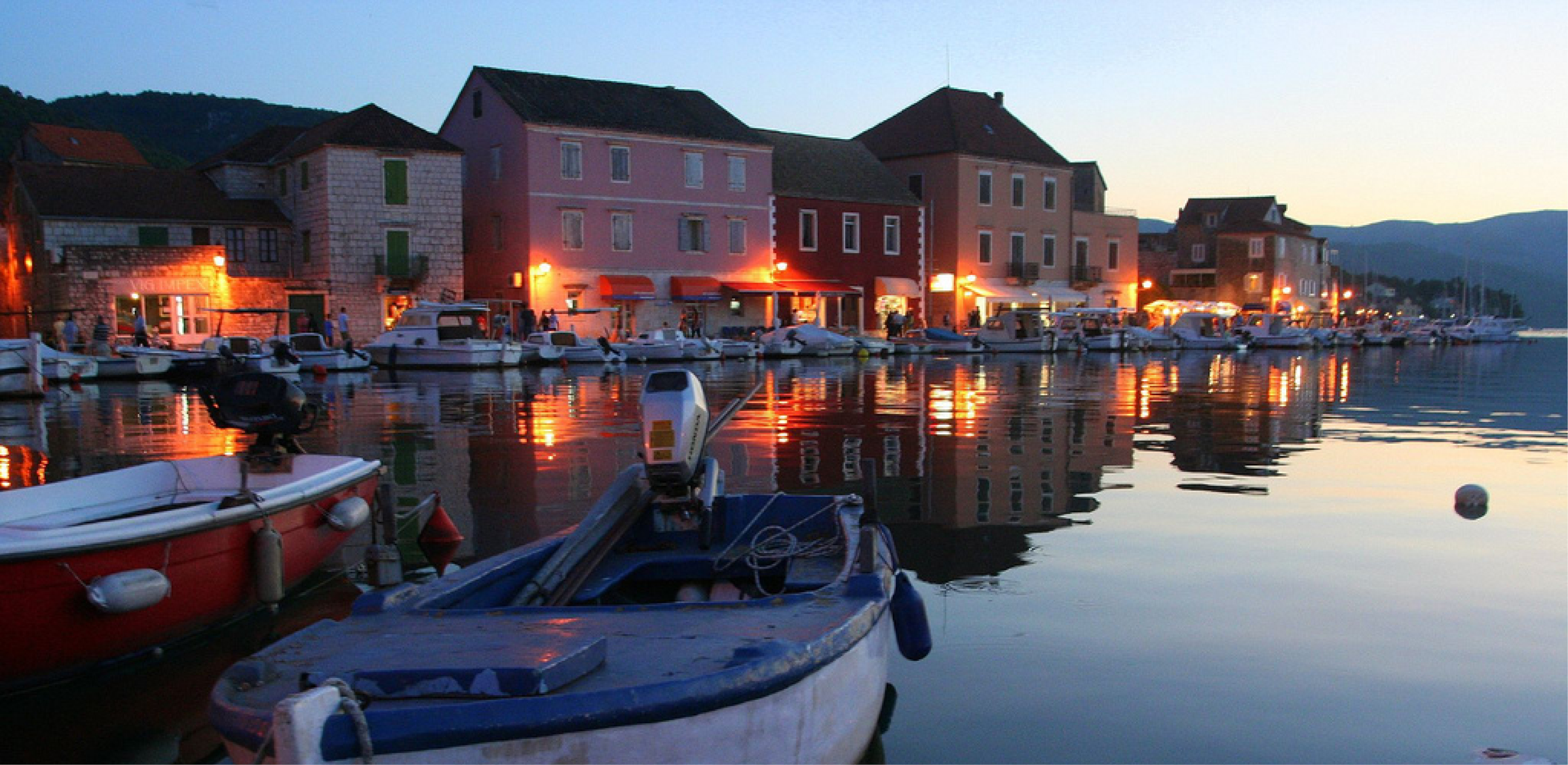
Academic Program: Summer Program for Croatian Language (Zadar, Croatia)

Deadline for Applications: March 01, 2017

zadar-program-image

Language Institute in Zadar, Croatia

The University of Kansas Department of Slavic Languages and Literatures and the Office of Study Abroad offer students the opportunity to spend the summer in Zadar, Croatia, studying Croatian language and culture. The University of Kansas has more than 30 years of involvement in Croatian language programs.

Location: Zadar, Croatia
Language of Instruction: Croatian
Term: Summer
Academic Disciplines: Slavic Languages & Literatures
Program Type: Faculty-led

Highlights:

  • Spend 6 weeks in the summer studying intensive Croatian language
  • Live in a small ancient Dalmatian town right along the Adriatic coast completely immersed in Croatian culture
  • Enjoy afternoon and evening lectures (in Croatian), films, and visits to museums
  • Take day trips and excursions to nearby islands, historical attractions and national parks

For more information, and to apply, click here.